


Why Some Eyes Never Work Together—and How Binocular Vision Evaluation Fixes It
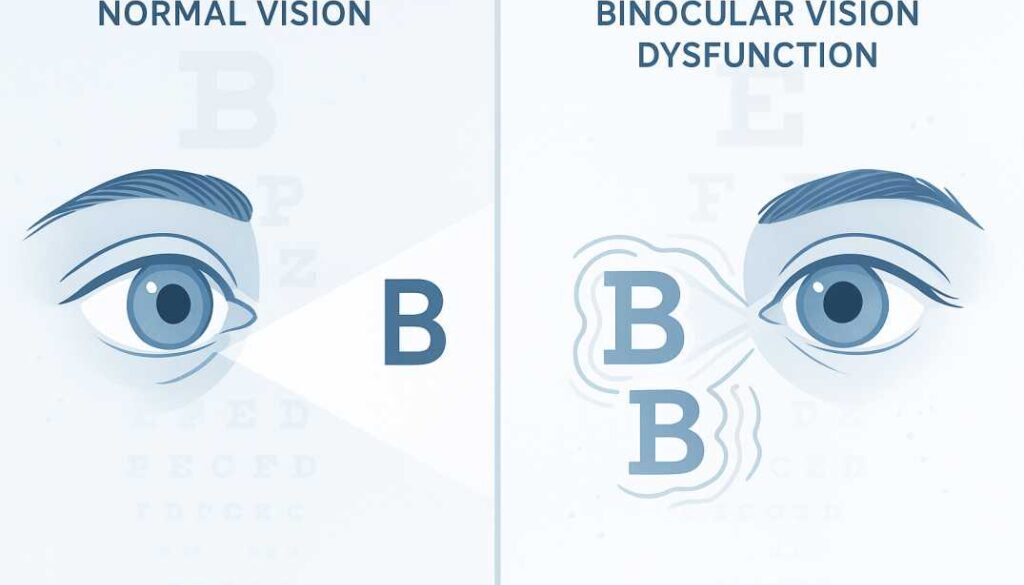
Seeing Clearly Isn’t Always Seeing Correctly
Many patients assume that if they can read the eye chart, their vision is fine. But clear sight does not always mean healthy visual function.
Binocular vision refers to how well the eyes work together as a team. When that coordination breaks down, patients may experience symptoms that feel unrelated to their eyes at all.
What Is Binocular Vision Dysfunction?
Binocular vision dysfunction (BVD) occurs when the eyes struggle to align, focus, or move together efficiently. Even small misalignments can cause the brain to work overtime to maintain single vision.
Over time, this strain can affect comfort, attention, and performance.
Common Symptoms That Are Often Missed
Patients with binocular vision issues may report:
Frequent headaches or eye strain
Difficulty reading or concentrating
Fatigue after visual tasks
Words moving or blurring on the page
Poor depth perception
Motion sensitivity or dizziness
Because these symptoms overlap with stress, migraines, or learning difficulties, the eyes are often overlooked as the source.
Why a Standard Eye Exam May Not Catch It
Traditional eye exams focus on visual acuity and eye health. While essential, they don’t always assess how the eyes work together under real-world conditions like reading, screen use, or sports.
A binocular vision evaluation looks deeper—measuring eye alignment, tracking, focusing flexibility, and visual stamina.
Who Benefits from a Binocular Vision Evaluation?
This evaluation is especially valuable for:
Children with reading or learning challenges
Students with attention or focus complaints
Adults with screen-related fatigue
Athletes who rely on depth perception and reaction time
Patients with persistent symptoms despite “normal” eye exams
Treatment Options After Diagnosis
Once identified, binocular vision issues are highly treatable. Care plans may include:
Vision therapy
Specialized lenses or prisms
Targeted at-home exercises
Ongoing monitoring of visual function
Treatment is customized to the patient’s needs, lifestyle, and visual demands.
Why This Matters in Today’s Visual World
Modern life demands more from our eyes than ever—extended near work, screens, multitasking, and visual speed. When the eyes aren’t working together efficiently, performance and comfort suffer.
Addressing binocular vision doesn’t just improve sight—it improves quality of life.
Final Thoughts
If vision feels tiring, uncomfortable, or inconsistent, clarity may not be the issue. A binocular vision evaluation can uncover hidden problems and open the door to meaningful improvement.
Sometimes, the solution isn’t stronger glasses—it’s better teamwork between the eyes.


WHERE TO FIND US Our Locations

© 2026 Evolutionary Eye Care . All Rights Reserved. Accessibility Statement - Privacy Policy - Sitemap
Powered by:

