
Why Your Eyes Feel Like Sandpaper?And the "Liquid Bandage" That Finally Stops the Burn.
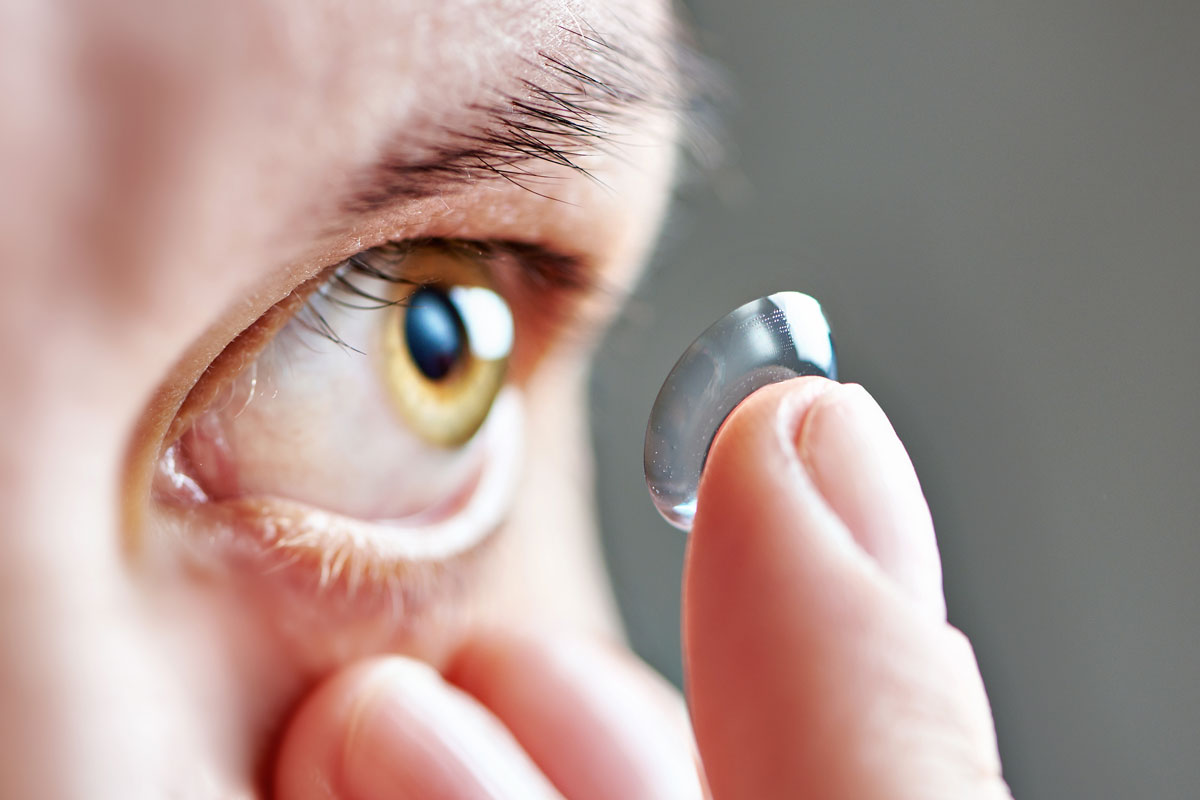
The Constant Aquarium: A New Way to Treat Dry Eye
For those living with severe dry eye in Downtown Houston or Webster, life is often measured in “drops per hour.” You plan your day around artificial tears, avoiding air-conditioned offices or the Texas wind because the burning and grittiness are simply too much to handle.
At Evolutionary Eye Care, we believe you shouldn’t have to live your life 15 minutes at a time. This is where the medical breakthrough of the scleral lens—often called the “liquid bandage”—comes in.
What Is a “Liquid Bandage”?
Standard contact lenses sit directly on the cornea, which can often make dry eye symptoms worse by absorbing your natural tears. A scleral lens does the opposite.
It is a large-diameter, gas-permeable lens that “vaults” completely over the sensitive cornea and rests on the white part of the eye (the sclera). Before inserting the lens, you fill it with a preservative-free saline solution.
The result: your cornea is bathed in a constant, soothing reservoir of moisture for 12 to 14 hours a day. It’s essentially a private “mini-aquarium” for your eye.
The Healing Power of the Reservoir
As a therapeutic optometrist in Downtown Houston, we use scleral lenses as a medical treatment to:
- Protect corneal nerves
By shielding the eye from friction caused by blinking, the “liquid bandage” allows hypersensitive nerves to calm down. - Promote surface healing
If you have corneal scarring or surface irregularities from chronic dryness, the constant hydration creates an environment where the eye can repair itself. - Block environmental irritants
The lens acts as a physical barrier against dust, wind, and allergens common in Sugar Land and Houston.
Who Benefits Most?
While scleral lenses are the gold standard for keratoconus in Webster, TX, they are increasingly used as a primary treatment for:
- Sjögren’s Syndrome & GvHD
Conditions where natural tear production is extremely low or absent. - Post-LASIK complications
For patients experiencing dryness due to nerve disruption after surgery. - Severe MGD (Meibomian Gland Dysfunction)
Often combined with Low-Level Light Therapy (LLLT) at our Dry Eye Center of Excellence in Houston to treat the root cause while lenses provide immediate relief.
Medical Eye Exam vs. Routine Vision Test
Scleral lenses are not available at high-volume retail optical shops. Fitting them is a highly specialized medical process.
We use 3D corneal topography to map the exact peaks and valleys of your eye, ensuring the lens vaults perfectly without touching delicate corneal tissue.
This is the “Evolutionary” difference: we don’t just aim for 20/20 vision—we focus on eyes that are healthy, hydrated, and pain-free.
Conclusion: Stop Managing, Start Healing
If you’re tired of the “drop-refill-repeat” cycle, it’s time to consider a medical solution that works as hard as you do.
Scleral lenses offer a level of comfort and visual clarity that traditional treatments simply can’t match.
Medical evidence and important limits
For keratoconus, improving vision and slowing disease progression are different goals. Specialty lenses may improve vision; they do not stop progression. Cross-linking may be considered for progressive disease after specialist assessment. See Mayo Clinic’s treatment guidance.
Contact lenses can cause serious infection or corneal ulcers. Follow the prescribed wear and cleaning plan, avoid water exposure and keep follow-up appointments. With pain, unusual redness, light sensitivity or blurred vision, remove the lenses and seek prompt professional advice. FDA contact-lens safety guidance.
Sources for these clinical explanations
These references support the general explanations above; they do not verify practice-specific outcomes or guarantee results. This educational article is not a diagnosis or a substitute for an individual examination.
Explore your care options in Greater Houston
Read about our optometrists and their training, then contact your preferred office to confirm service availability and arrange an evaluation: Downtown Houston, Webster or Sugar Land.


